
Ancient Christian Ecopoetics
Cosmologies, Saints, Things
Our rough guess is there are 74,000 words in this book.
At a pace averaging 250 words per minute, this book will take 4 hours and 56 minutes to read. With a half hour per day, this will take 10 days to read.
How long will it take you?
This book will take an estimated to read at a reading speed averaging words per minute. With 30 minutes per day, this will take to read.
Enter your reading speedYou can take one of our WPM reading speed tests to find your reading speed.
Create a free account to track your reading progress, build your reading list, and set reading goals.
Word Count
74,000 words, Guess
Page Count
296 pages
Physical Format
Hardcover
Identifiers
- ISBN-100812250796
- ISBN-139780812250794
- Library of Congress Control Number2018015361
- OCLC Control Number1031424876
- Better World Books9780812250794
and 2 more
- Better World BooksP8-CPU-304
- Open LibraryOL27359644M
Classifications
- LCCBT695.5.B855 2018
- LCCBT695.5 .B855 2019
Description
"In our age of ecological crisis, what insights—if any—can we expect to find by looking to our past? Perhaps, suggests Virginia Burrus, early Christianity might yield usable insights. Turning aside from the familiar specter of Christianity's human-centered theology of dominion, Burrus directs our attention to aspects of ancient Christian thought and practice that remain strange and alien. Drawn to excess and transgression, in search of transformation, early Christians creatively reimagined the universe and the human, cultivating relationships with a wide range of other beings—animal, vegetable, and mineral; angelic and demonic; divine and earthly; large and small. In Ancient Christian Ecopoetics, Burrus facilitates a provocative encounter between early Christian theology and contemporary ecological thought. In the first section, she explores how the mysterious figure of khora, drawn from Plato's Timaeus, haunts Christian and Jewish accounts of a creation envisioned as varyingly monstrous, unstable, and unknowable. In the second section, she explores how hagiographical literature queers notions of nature and places the very category of the human into question, in part by foregrounding the saint's animality, in part by writing the saint into the landscape. The third section considers material objects, as small as portable relics and icons, as large as church and monastery complexes. Ancient Christians considered all of these animate beings, simultaneously powerful and vulnerable, protective and in need of protection, lovable and loving. Viewed through the shifting lenses of an ancient ecopoetics, Burrus demonstrates how humans both loomed large and shrank to invisibility, absorbed in the rapture of a strange and animate ecology."--
Subjects
Topics
Other Editions
- Ancient Christian Ecopoetics: Cosmologies, Saints, Things
Similar Books

Creation and the God of Abraham
edited by David Burrell ... [et al.].

From Paul to Valentinus: Christians at Rome in the first two centuries
Peter Lampe ; translated by Michael Steinhauser ; edited by Marshall D. Johnson.

The rise of Western Christendom: triumph and diversity, A.D. 200-1000
Peter Brown.
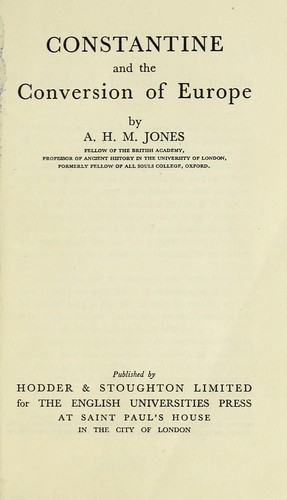
Constantine and the conversion of Europe.
A. H. M. Jones
Reader Reviews
No reviews yet for this book.
Be the first to share your thoughts!