
Cosmology and the polis
the social construction of space and time in the tragedies of Aeschylus
Our rough guess is there are 95,000 words in this book.
At a pace averaging 250 words per minute, this book will take 6 hours and 20 minutes to read. With a half hour per day, this will take 13 days to read.
How long will it take you?
This book will take an estimated to read at a reading speed averaging words per minute. With 30 minutes per day, this will take to read.
Enter your reading speedYou can take one of our WPM reading speed tests to find your reading speed.
Create a free account to track your reading progress, build your reading list, and set reading goals.
Author
Publication
2012 - Cambridge University Press, Cambridge, England
Language
English
Word Count
95,000 words, Guess
Page Count
380 pages
Identifiers
- ISBN-101107009278
- ISBN-139781107009271
- WikidataQ57945878
- Library of Congress Control Number2011041583
- OCLC Control Number753630544
and 2 more
- Better World Books9781107009271
- Open LibraryOL25094330M
Classifications
- DDC882/.01
- LCCPA3829 .S37 2012
Description
"This book further develops Professor Seaford's innovative work on the study of ritual and money in the developing Greek polis. It employs the concept of the chronotope, which refers to the phenomenon whereby the spatial and temporal frameworks explicit or implicit in a text have the same structure and uncovers various such chronotopes in the Homeric Hymn to Demeter and in particular the tragedies of Aeschylus. Mikhail Bakhtin's pioneering use of the chronotope was in literary analysis. This study by contrast derives the variety of chronotopes manifest in Greek texts from the variety of socially integrative practices in the developing polis - notably reciprocity, collective ritual, and monetised exchange. In particular, the tragedies of Aeschylus embody the reassuring absorption of the new and threatening monetised chronotope into the traditional chronotope that arises from collective ritual with its aetiological myth"-- "This book further develops Professor Seaford's innovative work on the study of ritual and money in the developing Greek polis. It employs the concept of the chronotope, which refers to the phenomenon whereby the spatial and temporal frameworks explicit or implicit in a text have the same structure, and uncovers various such chronotopes in the Homeric Hymn to Demeter and in particular the tragedies of Aeschylus. Mikhail Bakhtin's pioneering use of the chronotope was in literary analysis. This study by contrast derives the variety of chronotopes manifest in Greek texts from the variety of socially integrative practices in the developing polis - notably reciprocity, collective ritual and monetised exchange. In particular, the tragedies of Aeschylus embody the reassuring absorption of the new and threatening monetized chronotope into the traditional chronotope that arises from collective ritual with its aetiological myth"--
Subjects
Topics
People
Other Editions
- Cosmology and the polis: the social construction of space and time in the tragedies of Aeschylus
Similar Books

Prometheus bound
Aeschylus ; translated by George Thomson.

Septem contra Thebas
Aeschylus

Aeschylus: the earlier plays and related studies
D.J. Conacher.
The Agamemnon of Aeschylus: a commentary for students
by David Raeburn and Oliver Thomas
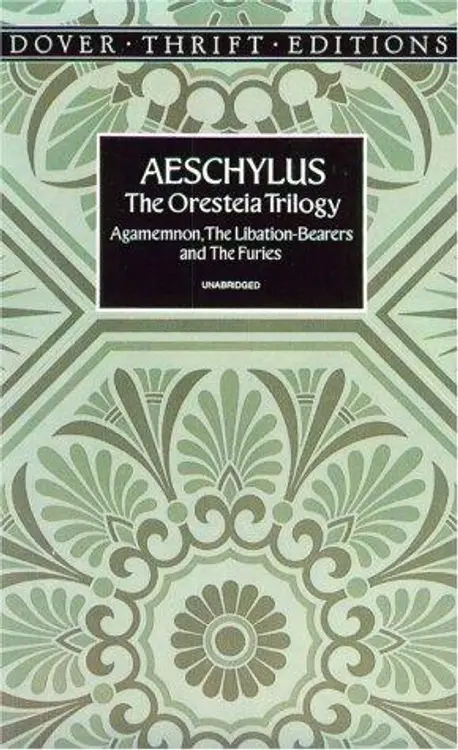
The Oresteia trilogy
Aeschylus ; translated by E.D.A. Morshead.

Aeschylus & Sophocles: their work and influence.
John Tresidder Sheppard

L' insignifiance tragique: "Les Choéphores" d'Eschyle, "Electre" de Sophocle, "Electre" d'Euripide
Florence Dupont.
Reader Reviews
No reviews yet for this book.
Be the first to share your thoughts!