
The Mathematics of Internet Congestion Control
Our rough guess is there are 41,000 words in this book.
At a pace averaging 250 words per minute, this book will take 2 hours and 44 minutes to read. With a half hour per day, this will take 6 days to read.
How long will it take you?
This book will take an estimated to read at a reading speed averaging words per minute. With 30 minutes per day, this will take to read.
Enter your reading speedYou can take one of our WPM reading speed tests to find your reading speed.
Create a free account to track your reading progress, build your reading list, and set reading goals.
Word Count
41,000 words, Guess
Page Count
164 pages
Physical Format
[electronic resource] /
Identifiers
- Open LibraryOL27073398M
- ISBN-139781461264989
- ISBN-101461264987
- OCLC Control Number853263515
- OCLC Control Numbermathematicsinter00srik
and 1 more
- LibraryThing1654483
Classifications
- DDC519
- LCCQ295
Description
Congestion control algorithms were implemented for the Internet nearly two decades ago, but mathematical models of congestion control in such a large-scale are relatively new. This text presents models for the development of new protocols that can help make Internet data transfers virtually loss- and delay-free. Introduced are tools from optimization, control theory, and stochastic processes integral to the study of congestion control algorithms. Features and topics include: * A presentation of Kelly's convex program formulation of resource allocation on the Internet; * A solution to the resource allocation problem which can be implemented in a decentralized manner, both in the form of congestion control algorithms by end users and as congestion indication mechanisms by the routers of the network; * A discussion of simple stochastic models for random phenomena on the Internet, such as very short flows and arrivals and departures of file transfer requests. Intended for graduate students and researchers in systems theory and computer science, the text assumes basic knowledge of first-year, graduate-level control theory, optimization, and stochastic processes, but the key prerequisites are summarized in an appendix for quick reference. The work's wide range of applications to the study of both new and existing protocols and control algorithms make the book of interest to researchers and students concerned with many aspects of large-scale information flow on the Internet.
Subjects
Topics
Series Statement
- Systems & Control: Foundations & Applications
Other Editions
- The Mathematics of Internet Congestion Control
Similar Books

Empirical Estimates in Stochastic Optimization and Identification
by Pavel S. Knopov, Evgeniya J. Kasitskaya
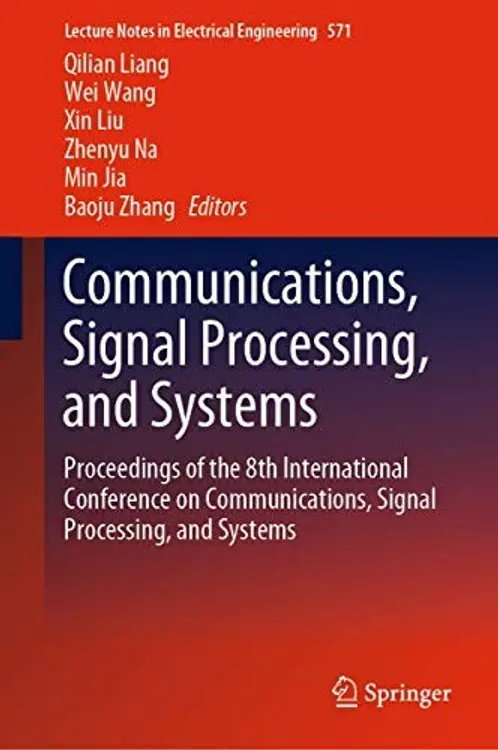
Communications, Signal Processing, and Systems: Proceedings of the 8th International Conference on Communications, Signal Processing, and Systems
Qilian Liang, Wang, Wei, Baoju Zhang, Zhenyu Na, Min Jia, Liu, Xin

Vector Lyapunov functions and stability analysis of nonlinear systems
by V. Lakshmikantham, V.M. Matrosov, and S. Sivasundaram.

Probability and Partial Differential Equations in Modern Applied Mathematics (The IMA Volumes in Mathematics and its Applications)
Edward C. Waymire, Jinqiao Duan
Reader Reviews
No reviews yet for this book.
Be the first to share your thoughts!