
Redeeming the great emancipator
Our rough guess is there are 47,250 words in this book.
At a pace averaging 250 words per minute, this book will take 3 hours and 9 minutes to read. With a half hour per day, this will take 6 days to read.
How long will it take you?
This book will take an estimated to read at a reading speed averaging words per minute. With 30 minutes per day, this will take to read.
Enter your reading speedYou can take one of our WPM reading speed tests to find your reading speed.
Create a free account to track your reading progress, build your reading list, and set reading goals.
Word Count
47,250 words, Guess
Page Count
189 pages
Identifiers
- ISBN-100674286111
- ISBN-139780674286115
- Library of Congress Control Number2015017376
- OCLC Control Number906121656
- Better World Books9780674286115
and 2 more
- Better World BooksP9-BKB-584
- Open LibraryOL27202413M
Classifications
- DDC973.7092
- LCCE457.2 .G886 2016
- LCCE457.2.G886 2016
Description
The larger-than-life image Abraham Lincoln projects across the screen of American history owes much to his role as the Great Emancipator during the Civil War. Yet this noble aspect of Lincoln's identity is precisely the dimension that some historians have cast into doubt. In a vigorous defense of America's sixteenth president, award-winning historian and Lincoln scholar Allen Guelzo refutes accusations of Lincoln's racism and political opportunism, while candidly probing the follies of contemporary cynicism and the constraints of today's unexamined faith in the liberating powers of individual autonomy. Redeeming the Great Emancipator enumerates Lincoln's anti-slavery credentials, showing that a deeply held belief in the God-given rights of all people steeled the president in his commitment to emancipation and his hope for racial reconciliation. Emancipation did not achieve complete freedom for American slaves, nor was Lincoln entirely above some of the racial prejudices of his time. Nevertheless, his conscience and moral convictions far outweighed political calculations in ultimately securing freedom for black Americans. Guelzo clarifies the historical record concerning what the Emancipation Proclamation did and did not accomplish. As a policy it was imperfect, but it was far from ineffectual, as some accounts of African American self-emancipation imply. To achieve liberation required interdependence across barriers of race and status. If we fail to recognize our debt to the sacrifices and ingenuity of all the brave men and women of the past, Guelzo says, then we deny a precious part of the American and, indeed, the human community.
Subjects
Topics
Places
People
Series Statement
- The Nathan I. Huggins lectures
- Nathan I. Huggins lectures
Similar Books
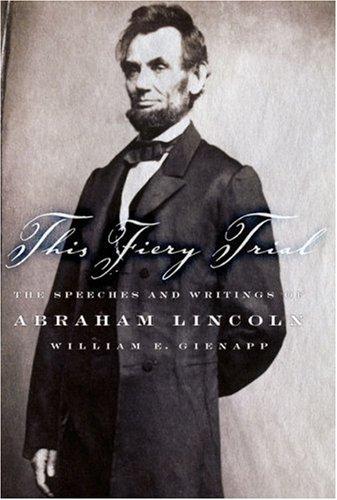
This fiery trial: the speeches and writings of Abraham Lincoln
edited by William E. Gienapp.
The Emancipation Proclamation: the National Archives experience
Franklin, John Hope, United States. President (1861-1865 : Lincoln)

Abraham Lincoln, Slavery, and the Civil War: Selected Writings and Speeches (The Bedford Series in History and Culture)
Abraham Lincoln
Reader Reviews
No reviews yet for this book.
Be the first to share your thoughts!